Intermittent bonded ribbon production line explained
Equipment for producing rollable formats in optical-fiber manufacturing is provided by Shanghai Weiye Optic Fiber Communication Equipment Co., Ltd. This setup is designed for 12- and 16-fiber ribbons, allowing buyers to assess its capacity against their planned product range. Factory space and installation needs may also be affected by the system’s split-type construction.
Fiber Draw Tower
Compact Fiber Unit
Fiber Secondary Coating Line
The stated construction speed for this particular production line is 600 m/min. Fiber pay-off, gathering and guiding, intermittent resin dispensing, UV-LED curing, visual monitoring, capstan pulling, and take-up are integrated in the process. The full process is important to evaluate, not just the stated speed.
Factory utilities, reel requirements, available floor space, and installation conditions should be reviewed before purchase. Ask the supplier for its documentation package and check the system’s suitability for your cable design and operating requirements. Early planning for these details can reduce setup delays and make startup smoother.
Main Takeaways
- Intended to produce rollable 12- and 16-fiber formats.
- Listed speed: 600 m/min for this equipment.
- Uses a split-type construction.
- Curing, monitoring, pulling, and take-up stages are included.
- Before purchasing, verify utilities, reels, installation requirements, and supplier documentation.
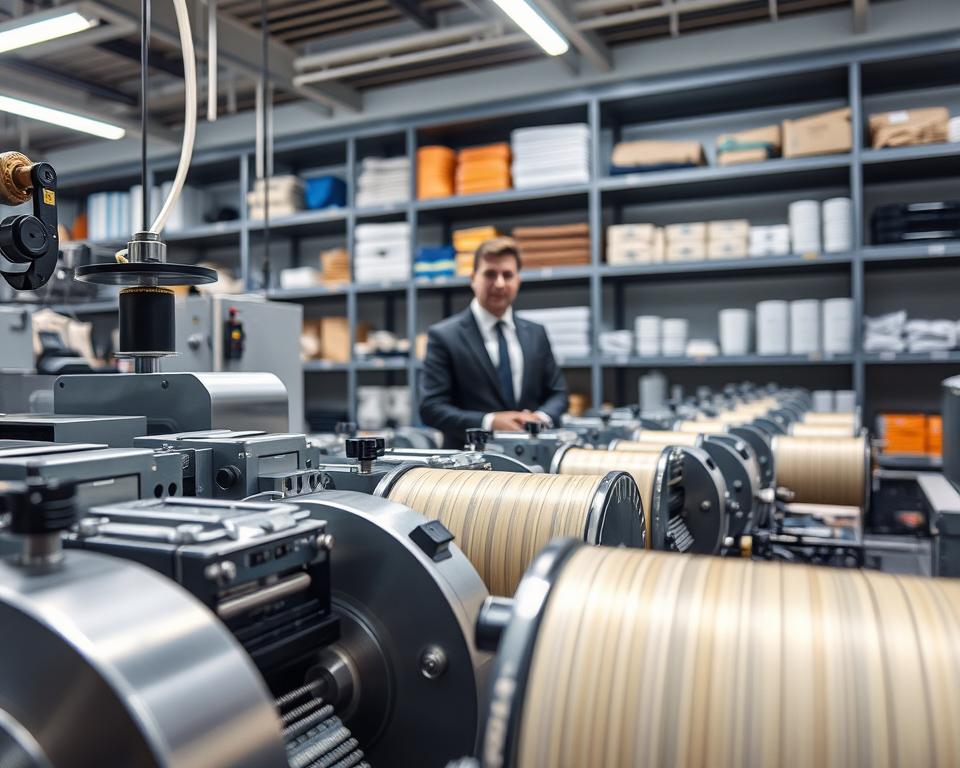 Intermittent Bonded Ribbon Production Line
Examine The Intermittent Bonded Ribbon Production Line
To create rollable IBR formats, three mold groups position fibers for the application of small adhesive dots. Mold position is adjustable by operators from 0 to 15 mm, helping produce consistent spacing and form.
Produce Rollable Fiber Ribbons With Precision Bonding
The machine is supplied by a 16-spool pay-off, and guide rollers with U-shaped grooves help maintain the organization of each strand. Steady contact during processing is supported by the rollers’ hard-anodized surfaces. The adjustable valve arrangement supports 12F and 16F layouts, using 5+5+1 valves for 12 fibers or 5+5+5 for 16. Confirm the appropriate tension control settings with the supplier for your cable design.
Run 12- And 16-Fiber Configurations At Up To 600 m/min
Construction speed is specified at up to 600 m/min. Pay-off reel options hold 25.2 km or 50.4 km of fiber according to the listed reel dimensions: Φ236 mm × Φ25.4 mm × 108 mm and Φ267 mm × Φ25.4 mm × 180 mm. T-type and fiber-optic take-up reels are also offered for this system. Assess whether reel capacity matches your operating needs and anticipated changeover time.
Review The Production Line’s Key Equipment And Controls
Tension, resin placement, and UV exposure must work together to deliver reliable output. Operators can use the system to align settings with the needs of their cable design and fiber ribbon.
Coordinate Fiber Tension, Resin Dispensing, And UV-LED Curing
Electro-pneumatic adjustment is provided for each pay-off unit. Dispensers can run independently or in linked groups, with adhesive-dot spacing and counts configured through the interface.
Three pre-curing ovens support the mold groups ahead of UV-LED post-curing. Ask the supplier to check resin compatibility and the relevant operating conditions.
Lamp current, oven temperature, alarms, and preset lengths are monitored or managed through the Siemens PLC and touchscreen. Before purchase, verify cabinet requirements and power supply needs.
| Stage | Technical Specification | Buyer check |
| Tension of fibers | Pay-off: 0.4 to 2 N, ±0.02 N; capstan: 50 to 500 g, ±5 g accuracy | Align settings with cable requirements |
| Dispensing of resin | Individually operated or linked units with adjustable adhesive-dot spacing and count | Check interface configuration |
| UV-LED curing | Three 800 W pre-curing ovens; one 6 kW post-curing oven; 395 nm ± 3 nm; at least 85% cure under stable, high-speed conditions | Confirm resin compatibility |
| Monitoring | Siemens S7-1200 or S7-1500 PLC; 10.4-inch touchscreen; real-time lamp current and oven temperature, alarms, preset lengths | Verify cabinet and power supply requirements |
Prepare Line Configuration, Installation, And Operating Conditions
Before the machine is delivered, prepare a dedicated operating area. An enclosed, clean, dry, draft-free space is needed for the optical fibre system. Maintain temperatures between 15°C and 25°C and humidity at or below 85%. These conditions help safeguard fiber equipment and maintain precision during operation.
With your facilities team, check site utilities, available electrical capacity, cabinet space, and cable design. Nitrogen at 7 bar with 99.99% purity and compressed air at 6 bar are specified for the system. The electrical supply must be three-phase, five-wire, and 380 V ±10%.
- Allow space for the cabinet, components, resin, and access to service parts. Verify temperature settings and tension control before startup.
- Account for the specified reel size of Φ410 mm × Φ50.8 mm × 391 mm. The take-up unit accepts reels weighing up to 30 kg.
- Include the main power feed-in cable in your site plan. The equipment package does not include connection cables and cable trays.
Before ordering, verify the supply scope, reel types, and installation requirements. Reviewing these items may reduce setup time and avoid subsequent delays. Request supplier confirmation of appropriate settings for your fiber and cable design, including lamp accuracy and operating conditions. Clear planning supports a smoother startup for the production system.
Request Pricing For A Ribbon Production Solution Tailored To Your Needs
Manufacturers seeking rollable 12- or 16-fiber formats can assess this line at its stated speed of 600 m/min. Share details of your fiber layout, output targets, cable requirements, reel preferences, and factory conditions to request a quotation.
Confirm that the proposed system includes the 16-spool pay-off, UV-LED curing arrangement, take-up capacity, and relevant options. Before ordering, review the included components, dispensing-head options, unit functions, and cable design.
Listed documents include operating and maintenance manuals, a general layout drawing, electrical schematics, and a wear-parts list. Reviewing these documents can clarify setup time and future service requirements.
For pricing and configuration details matched to your production plan and site utilities, consult Shanghai Weiye Optic Fiber Communication Equipment Co., Ltd. Verify the supply scope and replacement parts before purchase.